

Patient Email: "Are Ross Procedure Patients at Higher Risk for Endocarditis?" asks Sara
Published: August 26, 2022
I just received a fantastic question from Sara, a Ross Procedure patient, in response to an article about endocarditis and heart valve disease featuring comments from Dr. David Kaczorowski, a leading cardiac surgeon from UPMC. Her question is about the statement, "If you have an acquired valve disease, artificial heart valve, congenital heart disease, or have a history of valvular disease, monitoring your health for endocarditis symptoms is especially important."

Given Dr. Kaczorowski's important point about endocarditis, Sara asked me, "Hi Adam - I had the Ross Procedure. So, it's not an artificial valve. Does that still put me at high risk?"
Ross Procedure Experts Say...
To provide Sara an expert answer to her question, I immediately contacted Dr. Paul Stelzer and Dr. Ismail El-Hamamsy.
As you may know, these two cardiac surgeons are Ross Procedure experts having collectively performed over 1,000 Ross Procedures during their extraordinary careers. They both work together now at Mount Sinai Hospital in New York City.

Within minutes of emailing Dr. Stelzer, I received the following response:
Adam, Thanks for your message and your ongoing efforts to help people with heart valve disease.The risk of endocarditis is lower for Ross Procedure than for either mechanical or animal tissue valves, but it still can happen. It can happen on either the aortic or the pulmonary (homograft) valve. Early diagnosis and antibiotic treatment is most often successful much like a native valve endocarditis but some will require further open surgery.My recommendation for Ross patients is to use prophylactic antibiotics before major dental work. Even cleanings can be considered for this. -- Paul Stelzer, MD

Then, just a few minutes later, I received the following response from Dr. El-Hamamsy:
Hi Adam, That's a good (and important) question. There always is a risk once the patient has had their valve replaced. That said, because the valve substitute in the Ross Procedure is a living autologous valve, the long-term risk of endocarditis (on both the aortic or pulmonary valves) is significantly lower than with an inert prosthetic valve (whether tissue or mechanical).Depending on the study, the risk is ~3-5 times lower after the Ross Procedure compared to a mechanical or biological prosthesis. -- Ismail El-Hamamsy, MD
Many thanks to Sara for her question! And, a special thanks to Dr. Paul Stelzer and Dr. Ismail El-Hamamsy for sharing their clinical research and patient experiences specific to the Ross Procedure and endocarditis.
Related Links:
Keep on tickin!
Adam
Written by Adam Pick - Patient & Website Founder

Written by Adam Pick - Patient & Website Founder
Adam Pick is a heart valve patient and author of The Patient's Guide To Heart Valve Surgery. In 2006, Adam founded HeartValveSurgery.com to educate and empower patients. This award-winning website has helped over 10 million people fight heart valve disease. Adam has been featured by the American Heart Association and Medical News Today.
Comments





Adam's Newest Blogs


New Community Posts
Blog Categories
- Adam's Updates
- Aneurysms
- Aortic Stenosis
- Aortic Valve Repair
- Aortic Valve Replacement
- Atrial Fibrillation
- Before Surgery
- Bicuspid Aortic Valve
- Heart Valve Replacement
- Medical Technology
- Mitral Regurgitation
- Mitral Valve Repair
- Patient Stories
- Pulmonary Valve
- Recovery
- Ross Procedure
- Surgeons & Hospitals
- Tricuspid Valve
Blog Categories
- Adam's Updates
- Aneurysms
- Aortic Stenosis
- Aortic Valve Repair
- Aortic Valve Replacement
- Atrial Fibrillation
- Before Surgery
- Bicuspid Aortic Valve
- Heart Valve Replacement
- Medical Technology
- Mitral Regurgitation
- Mitral Valve Repair
- Patient Stories
- Pulmonary Valve
- Recovery
- Ross Procedure
- Surgeons & Hospitals
- Tricuspid Valve
Blog Categories
- Adam's Updates
- Aneurysms
- Aortic Stenosis
- Aortic Valve Repair
- Aortic Valve Replacement
- Atrial Fibrillation
- Before Surgery
- Bicuspid Aortic Valve
- Heart Valve Replacement
- Medical Technology
- Mitral Regurgitation
- Mitral Valve Repair
- Patient Stories
- Pulmonary Valve
- Recovery
- Ross Procedure
- Surgeons & Hospitals
- Tricuspid Valve
The Patient's Guide
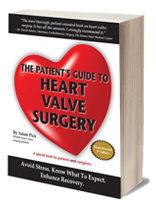
This book has helped over 47,000 patients and caregivers from diagnosis to recovery.









New Posts From Our Community


Find Heart Valve Surgeons
Search 1,500 patient-recommended surgeons
The Patient's Guide
This book has helped over 47,000 patients and caregivers from diagnosis to recovery.
Leave a Comment