

"Pradaxa For Atrial Fibrillation? Heart Valve Disease? Mechanical Heart Valve Replacements?" Asks Gene
I've received several questions about the use of Pradaxa as a potential Coumadin-substitute for patients with atrial fibrillation, valve disease and/or mechanical heart valve replacements. I am a "better safe than sorry" type guy, so I wanted to make sure our patient community was on the same page specific to this new anticoagulant.

For those of you unfamiliar with Pradaxa, it was approved by the FDA in October, 2010. Following the results of its RE-LY study, Pradaxa is now considered by some to be an alternative to Coumadin -- an established anticoagulant (blood thinner) for preventing strokes in patients with atrial fibrillation. During the RE-LY trial, patients with atrial fibrillation taking Pradaxa had fewer strokes compared to those using Coumadin.
In light of this news, patients in our community - including Gene - sent me questions about Pradaxa. I contacted Dr. Niv Ad, a leading cardiac surgeon at White Oak Medical Center in Takoma Park, Maryland, to learn more about this drug and its potential utility for patients with mechanical heart valve replacements.
So you know, Dr. Ad is known within the medical community for his unique research and treatment of atrial fibrillation. A testament to his patient advocacy efforts, Dr. Ad hosts an annual reunion for his patients who have had cardiac surgery due to a-fib.

I asked Dr. Ad four questions about Pradaxa and heart valve-related issues.
Question 1: How effective has Pradaxa been for patients suffering from A-Fib?
Pradaxa (Dabigatran) is an ORAL direct thrombin inhibitor indicated for stroke prevention in patients with non-valvular atrial fibrillation. Pradaxa is supplied as a capsule (75mg and 150mg) which is taken by mouth twice daily based on renal function (150mg twice a day for Creatinine Clearance> 30 ml/min; 75mg twice a day for Creatinine Clearance 15 – 30 ml/min). As always -- with these types of statements, patients should follow their own physician instructions. Patients on Pradaxa who cannot swallow the capsule should be switched to another anticoagulant. Pradaxa does not require regular monitoring to assess its effectiveness. Again, it is important to note, It is important to note, the drug is indicated only in patients with atrial fibrillation and no valvular disease! -- Dr. Niv Ad
Question 2: Is Pradaxa safe?
The drug is safe and approved for use by the FDA for the indications mentioned. However, the studies showed the following: In a study comparing Pradaxa to Coumadin, more Pradaxa patients developed gastrointestinal bleeding but fewer developed intracranial bleeding than warfarin patients. Bleeding is a risk with any anticoagulant. Dyspepsia can be an issue with Pradaxa but patients may take an H2 blocker (famotidine) or a proton pump inhibitor (pantoprazole) if it's bothersome. -- Dr. Niv Ad
Question 3: If patients have a mechanical heart valve replacement, can I use Pradaxa instead of Coumadin?
"NO!" -- Dr. Niv Ad
Question 4: If I have A-Fib and a mechanical heart valve replacement, can I take Pradaxa?
"NO!" -- Dr. Niv Ad
Considering Dr. Ad's responses to questions #3 and #4, I quickly came to see understand the appropriate uses of this drug relative to our patient community. In closing, Dr. Ad stressed, "Pradaxa, like Coumadin, is an anticoagulant and as such should only be taken under doctor's order with an appropriate prescription."
I hope this helps us all learn about Pradaxa relative to patients with atrial fibrillation, heart valve disease and/or mechanical heart valve replacements. Thanks to Gene for the questions. And, a special thanks to Dr. Niv Ad for sharing his clinical expertise.
Keep on tickin!
Adam
Written by Adam Pick - Patient & Website Founder

Written by Adam Pick - Patient & Website Founder
Adam Pick is a heart valve patient and author of The Patient's Guide To Heart Valve Surgery. In 2006, Adam founded HeartValveSurgery.com to educate and empower patients. This award-winning website has helped over 10 million people fight heart valve disease. Adam has been featured by the American Heart Association and Medical News Today.
Comments





Adam's Newest Blogs


New Community Posts
Blog Categories
- Adam's Updates
- Aneurysms
- Aortic Stenosis
- Aortic Valve Repair
- Aortic Valve Replacement
- Atrial Fibrillation
- Before Surgery
- Bicuspid Aortic Valve
- Heart Valve Replacement
- Medical Technology
- Mitral Regurgitation
- Mitral Valve Repair
- Patient Stories
- Pulmonary Valve
- Recovery
- Ross Procedure
- Surgeons & Hospitals
- Tricuspid Valve
Blog Categories
- Adam's Updates
- Aneurysms
- Aortic Stenosis
- Aortic Valve Repair
- Aortic Valve Replacement
- Atrial Fibrillation
- Before Surgery
- Bicuspid Aortic Valve
- Heart Valve Replacement
- Medical Technology
- Mitral Regurgitation
- Mitral Valve Repair
- Patient Stories
- Pulmonary Valve
- Recovery
- Ross Procedure
- Surgeons & Hospitals
- Tricuspid Valve
Blog Categories
- Adam's Updates
- Aneurysms
- Aortic Stenosis
- Aortic Valve Repair
- Aortic Valve Replacement
- Atrial Fibrillation
- Before Surgery
- Bicuspid Aortic Valve
- Heart Valve Replacement
- Medical Technology
- Mitral Regurgitation
- Mitral Valve Repair
- Patient Stories
- Pulmonary Valve
- Recovery
- Ross Procedure
- Surgeons & Hospitals
- Tricuspid Valve

The Patient's Guide
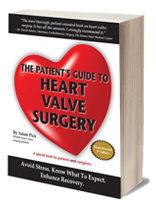
This book has helped over 47,000 patients and caregivers from diagnosis to recovery.
New Posts From Our Community


Find Heart Valve Surgeons
Search 1,500 patient-recommended surgeons
The Patient's Guide
This book has helped over 47,000 patients and caregivers from diagnosis to recovery.
Leave a Comment