

"Did You Get An M.R.I. Before Heart Valve Surgery?" Asks Gregg
Published: May 9, 2025
Through your stories and my ongoing research, I have learned that properly diagnosing heart valve disease can be tricky. That said, I always encourage patients to get a second opinion prior to any surgical treatment (if possible).
However, Gregg just sent me an interesting question about the use of M.R.I.'s as a diagnostic tool for valvular disorders. [If you have never seen an M.R.I. of the human heart before, please see below... Can you identify the two valves that are opening-and-closing in this image?]
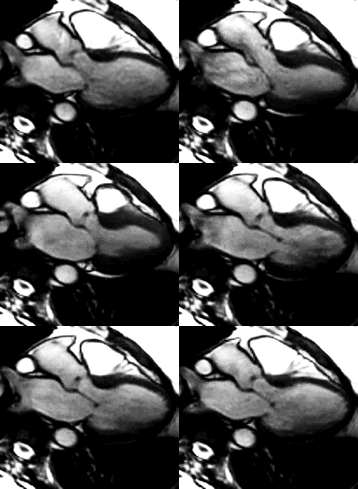
MRI of Heart Valves Functioning In The Heart
Gregg writes, "Hi Adam - Having been diagnosed with a bicuspid valve and an enlarged aorta, I am scheduled for a follow-up echocardiogram this month to determine if there have been any changes to my current condition. My question to you is whether an echo is okay or should I get an MRI? I ask this because during a consult with a surgeon - who is well known for his work in valve repair and valve replacement - he recommended an M.R.I. as a more thorough test. I am curious to know what you and your readers think? Thanks. Gregg"
In my experience, the use of an echocardiogram remains the non-invasive, industry standard for diagnosing heart valve diseases like aortic stenosis and mitral regurgitation. Furthermore, my gut tells me that echocardiogram machines which feature 3D technology will continue to preserve the widespread utility of echocardiograms as the non-invasive benchmark for valve disorder detection and monitoring.
However, I am aware of M.R.I. use as an alternative test for collecting additional information about heart valve disorders.
In fact, the National Heart and Lung Institute suggests, "Cardiac M.R.I. uses a powerful magnet and radio waves to make detailed images of your heart. A cardiac M.R.I. image can confirm information about valve defects or provide more detailed analysis. This information can help your doctor plan your treatment. An MRI also may be done before heart valve surgery to help your surgeon plan for the surgery."
So you know... Prior to my heart valve surgery, I did not have an M.R.I. performed. Instead, my cardiologists used two distinct echocardiograms to formally diagnose the severe stenosis of my aortic valve.
Related Links:
Medical Technology Update: See a 3D Echocardiogram Demonstration
Cardiac Imaging Alert: 4D Flow MRI for Bicuspid Aortic Valve and Aneurysm Risk Analysis
Did you have an M.R.I. as part of your diagnostic process? If so, please click leave a comment below. In advance, thanks for sharing your experience with all of us!!!
Keep on tickin!
Adam
Written by Adam Pick - Patient & Website Founder

Written by Adam Pick - Patient & Website Founder
Adam Pick is a heart valve patient and author of The Patient's Guide To Heart Valve Surgery. In 2006, Adam founded HeartValveSurgery.com to educate and empower patients. This award-winning website has helped over 10 million people fight heart valve disease. Adam has been featured by the American Heart Association and Medical News Today.
Comments





Adam's Newest Blogs


New Community Posts
Blog Categories
- Adam's Updates
- Aneurysms
- Aortic Stenosis
- Aortic Valve Repair
- Aortic Valve Replacement
- Atrial Fibrillation
- Before Surgery
- Bicuspid Aortic Valve
- Heart Valve Replacement
- Medical Technology
- Mitral Regurgitation
- Mitral Valve Repair
- Patient Stories
- Pulmonary Valve
- Recovery
- Ross Procedure
- Surgeons & Hospitals
- Tricuspid Valve
Blog Categories
- Adam's Updates
- Aneurysms
- Aortic Stenosis
- Aortic Valve Repair
- Aortic Valve Replacement
- Atrial Fibrillation
- Before Surgery
- Bicuspid Aortic Valve
- Heart Valve Replacement
- Medical Technology
- Mitral Regurgitation
- Mitral Valve Repair
- Patient Stories
- Pulmonary Valve
- Recovery
- Ross Procedure
- Surgeons & Hospitals
- Tricuspid Valve
Blog Categories
- Adam's Updates
- Aneurysms
- Aortic Stenosis
- Aortic Valve Repair
- Aortic Valve Replacement
- Atrial Fibrillation
- Before Surgery
- Bicuspid Aortic Valve
- Heart Valve Replacement
- Medical Technology
- Mitral Regurgitation
- Mitral Valve Repair
- Patient Stories
- Pulmonary Valve
- Recovery
- Ross Procedure
- Surgeons & Hospitals
- Tricuspid Valve









Heart Hospital Map

Search for heart hospitals that specialize in heart valve treatment.
New Posts From Our Community


Find Heart Valve Surgeons
Search 1,500 patient-recommended surgeons
Heart Hospital Map
Search for heart hospitals that specialize in heart valve treatment.
Leave a Comment